



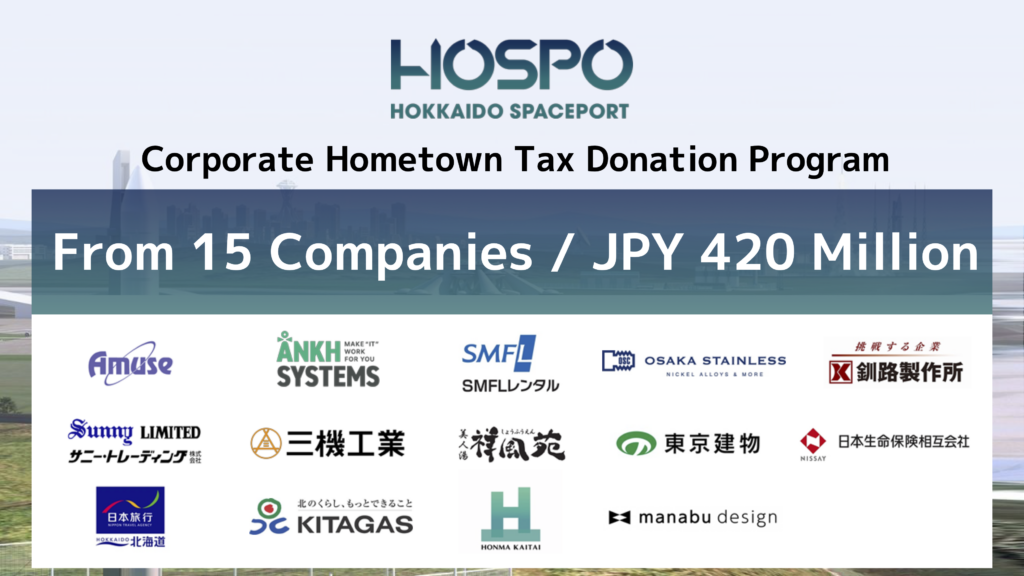
Between October and December 2025, Taiki Town Office received a corporate hometown tax donation of JPY 420 million (approximately USD 2.8 million) from 15 companies across Japan to support the development of Hokkaido Spaceport (HOSPO).
Taiki Town, together with SPACE COTAN Co., Ltd., operates Hokkaido Spaceport (HOSPO), a commercial spaceport open to private sector operators. The town has been accepting corporate hometown tax donations for two initiatives:
- Hard infrastructure development, including the expansion of HOSPO facilities, and
- Soft support programs, such as assistance for space-related companies and outreach to promote aerospace industries.
From the start of the fundraising campaign in April 2020 through December 2025, total donations amounted to JPY 3.49 billion from a cumulative total of 341 companies (JPY 1.81 billion allocated to infrastructure development and JPY 1.68 billion to soft support initiatives).
Taiki Town and SPACE COTAN are working toward the early realization of HOSPO’s vision of creating a “Space Silicon Valley”—a regional cluster for the aerospace industry—by advancing spaceport infrastructure development and supporting space-related businesses. Through these efforts, they aim to strengthen Japan’s space industry while promoting regional revitalization driven by the space sector.
Companies Supporting This Initiative
AMUSEMENT HOKKAIDO Co., Ltd.; ANKH SYSTEMS Co., Ltd.; SMFL Rental Company, Limited; Osaka Stainless Co., Ltd.; KUSHIROSEISAKUSHO Co., Ltd.; Sunny Limited; SANKI ENGINEERING CO.,LTD.; Sanko Co., Ltd.; Tokyo Tatemono Co., Ltd.; Nippon Life Insurance Company; NIPPON TRAVEL AGENCY HOKKAIDO CO.,LTD.; Hokkaido Gas Co., Ltd.; HONMA DEMOLITION Inc.; Manabu Design Inc.; and one additional company (undisclosed).
Government Support for Space Transportation Accelerates as Japan Moves Toward Autonomous Space Activities
With the rapid expansion of the global commercial space industry, the size of the world’s space market is projected to reach USD 1 trillion by 2040, nearly three times its current scale. Demand for satellite launches is increasing; however, due to limited domestic launch opportunities, many satellites are currently launched overseas.
In June 2023, the Japanese government approved a new Basic Plan on Space Policy, which sets forth the goal of securing independent access to space and achieving autonomous space activities without reliance on other nations. As one concrete measure, the Ministry of Education, Culture, Sports, Science and Technology (MEXT) allocated JPY 35 billion (approximately USD 230 million) over five years under the SBIR Phase 3 Program to support the development and demonstration of launch vehicles by private-sector startups.
In addition, the government established the JPY 1 trillion Space Strategy Fund (approximately USD 6.7 billion) to support technology development and commercialization by companies and universities. This fund also covers R&D for ground-based systems related to launch sites, including foundational technologies for spaceport infrastructure. The government has set a key target of securing around 30 domestic launches per year by the early 2030s, further accelerating support for Japan’s space transportation sector.
HOSPO Aims to Become a Next-Generation Launch Site Capable of High-Frequency, Multi-Vehicle Operations
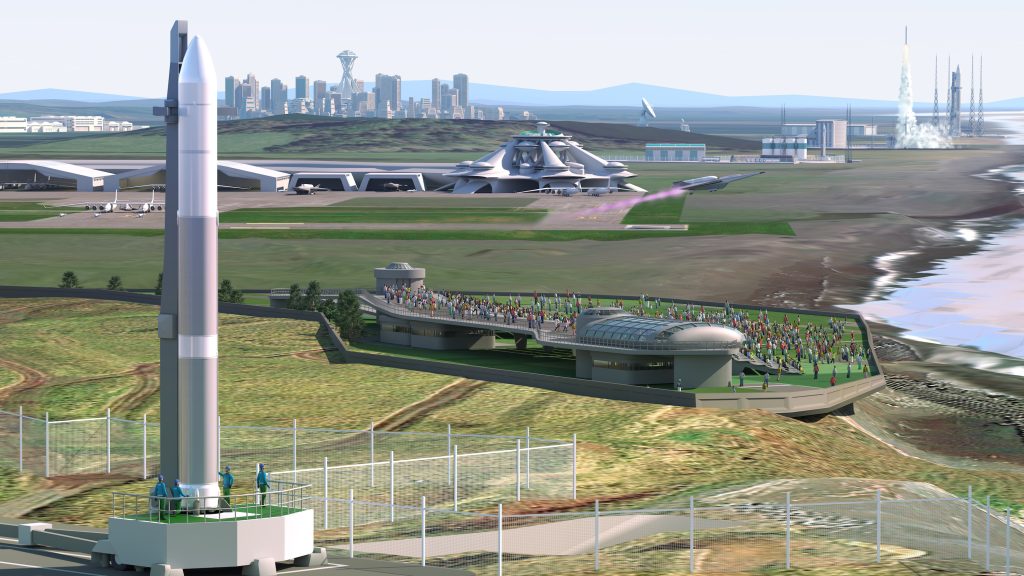
HOSPO is Japan’s only multi-mode spaceport capable of supporting both vertical and horizontal launch operations. Through the development of launch sites for rockets and spaceplanes, HOSPO provides launch and testing support for companies, universities, and research institutions from Japan and abroad. Approximately 40 tests and experiments are conducted annually, and in 2019 and 2021, commercial sounding rockets launched from HOSPO reached space a total of three times.
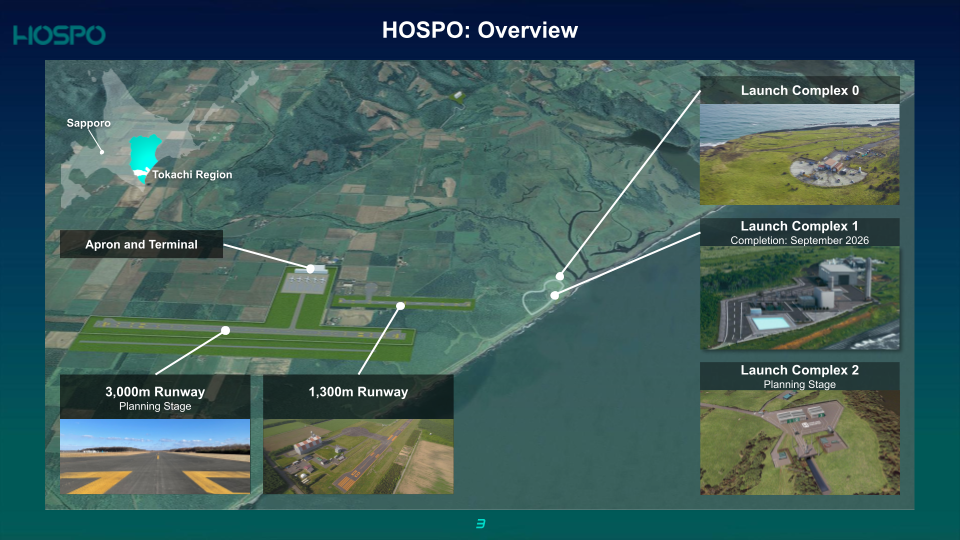
Since 2022, HOSPO has been engaged in the construction of Launch Complex 1 (LC1), designed for micro- to small-class launch vehicles capable of transporting payloads up to 2 tons to low Earth orbit. The spaceport has also completed an extension to its runway. A portion of the funding has come from Japan’s corporate hometown tax donation program. Thanks to the generous support of many contributors, total donations have reached a target of JPY 1.1 billion (approximately USD 7.3 million), although additional contributions continue to be sought owing to rising construction costs driven by surging material prices.
After LC1 is completed in September 2026, launches are planned by companies such as Interstellar Technologies Inc. The runway extension was completed in June 2024 and is expected to support testing for next-generation air mobility vehicles, including spaceplanes, flying cars, and drones.
To position HOSPO as a hub for the space industry in Asia and to enable frequent, diverse launch operations by domestic and international operators, plans are underway for the development of a second launch site—Launch Complex 2 (LC2)—as well as a 3,000-meter runway designed to accommodate point-to-point transportation (P2P).
About Hokkaido Spaceport (HOSPO)
HOSPO is a commercial spaceport open to the private sector, located in Taiki, Japan. For over 40 years, Taiki Town has sought to be home to the aerospace industry and is regarded as one of the most suitable locations for a world-class spaceport, thanks to its considerable geographic advantages: open seas to the east and south for launch trajectories and expansive land for future site expansion.
HOSPO’s suborbital launch site, Launch Complex 0 (LC0), is already operational, with private launch vehicles having reached space three times to date.
To realize its vision of creating a “Space Silicon Valley,” development is underway on a new orbital launch site, Launch Complex 1 (LC1). Future plans include Launch Complex 2 (LC2) for high-frequency launches, Launch Complex X (LCX) for larger and human-rated launch vehicles, and a new 3,000-meter runway for point-to-point transportation (P2P).
In October 2024, Taiki Town and SPACE COTAN signed a memorandum of understanding (MOU), committing to expand international spaceport collaboration with eight commercial spaceports located across five continents.
In order to meet the growing demand for launches, SPACE COTAN will explore potential strategic partnerships aimed at establishing international spaceport standards. Furthermore, SPACE COTAN was selected in January 2025 for the Japanese government’s Space Strategy Fund and will use the funding to develop ground-based technologies that support high-frequency launches of various launch vehicles.
In another milestone, in July 2025, jtSPACE Co., Ltd., a Japanese sister company of Taiwanese firm TiSPACE Inc., conducted the nation’s first suborbital rocket launch funded by foreign capital at HOSPO.