




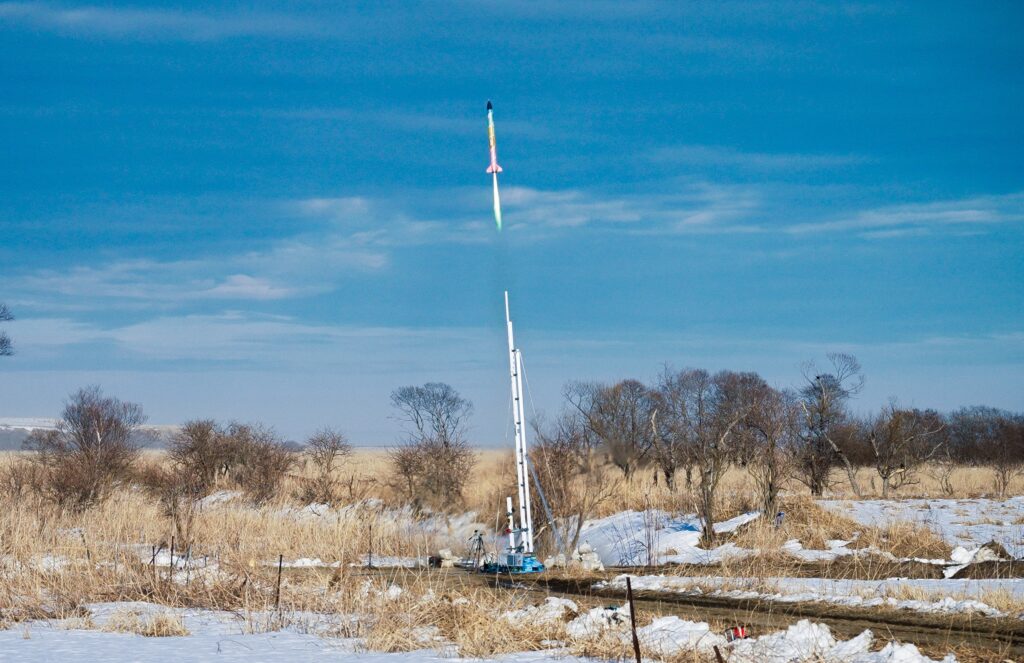
Taiki Town is pleased to announce that the SARD Hybrid Rocket Project (SARD), an officially recognized student organization at Muroran Institute of Technology, successfully conducted a hybrid rocket launch test in Taiki Town on March 14, 2026.
The main objectives of the test were to demonstrate a self-developed rocket engine, collect in‑flight data, including combustion pressure, and reach an altitude of 600 meters. As a result of the test, all systems were confirmed to have functioned as designed, and the rocket successfully reached its target altitude. Building on these results, SARD will continue development toward achieving spaceflight (above 100 km altitude).
SARD is an officially recognized aerospace manufacturing club at Muroran Institute of Technology. Students take the lead in all aspects of the project, including engine design and manufacturing, vehicle development, ground combustion testing, and launch operations. This was SARD’s first launch test conducted in Taiki Town.
Taiki Town currently hosts approximately 40 aerospace‑related experiments each year at Hokkaido Spaceport (HOSPO) and in the surrounding areas. The town remains committed to providing an environment that supports research and testing activities, thereby contributing to the advancement of the aerospace industry and the development of future talent.
Test Overview
- Test Date: March 14, 2026
- Location: Near Bisei, Taiki Town, Hiroo, Hokkaido
- Objective: Demonstration of a self-developed engine, collection of in-flight data, such as combustion pressure, and reaching an altitude of 600 m
- Result: The rocket reached an altitude of 712 meters and landed 185 meters southeast of the launch site. The launch was successful, confirming that the engine functioned as designed. The vehicle’s parachute also deployed successfully, enabling its recovery. Flight data and the recovered rocket will be studied to support the development of the next vehicle.
Rocket Specifications
- Name: H13-M2 Soranome
- Airframe: Modular structure of mainly GFRP (glass fiber reinforced plastic) tube construction
- Engine: Solid polyethylene fuel; gaseous oxygen oxidizer
- Length: 1.834 m
- Diameter: 13.5 cm
- Gross Weight: Approx. 11 kg
- Dry Weight: Approx. 10 kg
About Muroran Institute of Technology SARD Hybrid Rocket Project
- Faculty Advisor: Ryojiro Minato, Associate Professor, Graduate School of Engineering, Muroran Institute of Technology
- Student Leader: Anna Shima, 3rd-year student, Aerospace Engineering Course Department of Aerospace Engineering
- Location: 27-1 Mizumoto-cho, Muroran, Hokkaido, Japan
- Organization Overview: Founded in 2011, this university-recognized student organization is dedicated to the research and development of rockets, spacecraft, and satellites. Guided by the principle of “thinking and acting independently,” students take the initiative in all aspects of their activities.
- Website: https://muroransard.wixsite.com/sard
About Taiki Town
- Representative: Yutaka Kurokawa, Mayor
- Location: 33 Higashihondori, Taiki Town, Hiroo, Hokkaido, Japan
- Overview: A town with a population of 5,200 where agriculture, fishing, and forestry are the core industries. The town was recognized as suitable as a base for aerospace in 1984, and for over 40 years since then, the town has been promoting itself as a space town. In 2022, construction began on Launch Complex 1 (LC1), a new orbital launch site. The goal is to create an aerospace industry hub and ecosystem with Hokkaido Spaceport as its core.
- Website: https://www.town.taiki.hokkaido.jp/
About Hokkaido Spaceport (HOSPO)
HOSPO is a commercial spaceport open to the private sector, located in Taiki, Japan. For over 40 years, Taiki Town has sought to be home to the aerospace industry and is regarded as one of the most suitable locations for a world-class spaceport, thanks to its considerable geographic advantages: open seas to the east and south for launch trajectories and expansive land for future site expansion.
HOSPO’s suborbital launch site, Launch Complex 0 (LC0), is already operational, with private launch vehicles having reached space three times to date.
To realize its vision of creating a “Space Silicon Valley,” development is underway on a new orbital launch site, Launch Complex 1 (LC1). Future plans include Launch Complex 2 (LC2) for high-frequency launches, Launch Complex X (LCX) for larger and human-rated launch vehicles, and a new 3,000-meter runway for point-to-point transportation (P2P).
In October 2024, Taiki Town and SPACE COTAN signed a memorandum of understanding (MOU), committing to expand international spaceport collaboration with eight commercial spaceports located across five continents. In order to meet the growing demand for launches, SPACE COTAN will explore potential strategic partnerships aimed at establishing international spaceport standards.
Furthermore, SPACE COTAN was selected in January 2025 for the Japanese government’s Space Strategy Fund and will use the funding to develop ground-based technologies that support high-frequency launches of various launch vehicles. In another milestone, in July 2025, jtSPACE Co., Ltd., a Japanese sister company of Taiwanese firm TiSPACE Inc., conducted the nation’s first suborbital rocket launch funded by foreign capital at HOSPO.
In February 2026, Taiki Town and SPACE COTAN received the Minister of State for Space Policy Award at the 7th Space Development and Utilization Awards in recognition of their efforts in space-driven regional development centered on HOSPO.
